
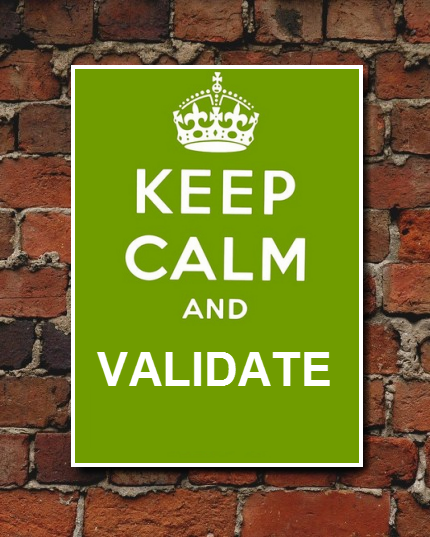
Has your partner ever said to you “You’re being too sensitive”, “It’s silly to feel that way”, or “Don’t be sad, just cheer up.”? Often, responses like these to our partner’s emotions are said out of caring and a desire to make our partner feel better. After all, when we love someone, we never want to see them feeling sad, angry, or disappointed. But, in saying these things, we are missing out on the opportunity to do something that can make a relationship so much stronger and more satisfying—we are missing the opportunity to validate our partner!
Validation means telling your partner you understand. It’s phrases like “I get it” or “You make sense” or “I can see your point”. It’s simple to do, but many couples get caught in the traps that prevent validation from happening. One of the biggest obstacles is that people assume that validation equals agreement. Yet, this is not the case at all. Let’s look at an example: A couple is having a discussion about their child wanting to go to college out of state. The mother feels she should stay closer to home because she is concerned she will be too homesick and not able to come home as easily. The father feels it will be good for their daughter and allow her to gain some independence. Think about the reaction the father may get if he says to his wife “You are being ridiculous for worrying. Of course, she will be just fine.” Although his intention would be to get his partner to stop worrying, it likely has the effect of making her feel dismissed or as if her feelings are unimportant. In contrast, consider this validating statement –“I can understand your concern about her being so far away; she tends to get homesick when she is gone”. Can you see how this statement would make his wife feel very differently? It is likely that with this validation, it would help to make his wife feel heard and understood. While the husband disagrees and feels completely differently, he can still relay his understanding of his wife’s feelings. (NOTE: He did not say “You’re right” or “I agree” or “Yes, she should stay in state”. THOSE would be agreements.) Validation communicates that we are accepted and understood for our point of view, even if there is not agreement or a decision.
Since validation seems easier said than done, here are some tips on engaging in this important pattern of communication:
Listen for the sake of listening-Listening is a skill that takes practice. But in order to validate, we need to be sure we are listening effectively. Very often, when we listen to our partner, we are thinking about what we want to say in response. By doing this, we prevent ourselves truly hearing our partner. Try putting your own thoughts and opinions on the back burner while your partner is speaking and listen just for the sake of listening. This will allow for more understanding of your partner’s viewpoint. In addition, being fully present while listening is equally important. Be sure to put down the phone, turn off the television and provide your partner with your full attention.
Try to put yourself into your partner’s shoes-Validation requires you to look at the world from your partner’s lens rather than what we are used to doing, which is viewing it from our own. We all have biological differences, personality differences and past experiences that affect the way we view present issues. If you are disagreeing with your partner about something, it is likely because you both are viewing it from your own lenses. When you are able to look at it from your partner’s lens and be willing to see it how they may see it, it allows for you to validate it. Again, you may disagree, but be able to say a validating statement such as “You make sense to me” when understanding our partner’s viewpoint.
Validation is a skill, like many others in a relationship, that will take practice. But it enhances closeness, lets defenses loosen and fall away, and paves the way for coming to a solution you both can feel good about. It’s not easy, but it can have a powerful, uniting effect. If you and your partner need help with this skill, or other relationship skills, please feel free to call us at 908-246-3074 or email at getsupport@couplestherapycenterofnj.com.
 partner to change, and c) blame, shame & criticism. This is ineffective communication at its finest. So how can we learn new ways to talk, and equally as important, listen to our partners to have effective communication instead?